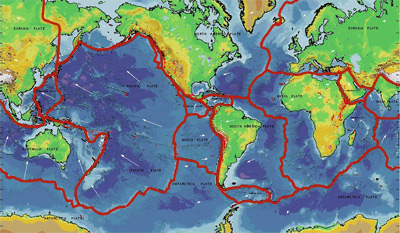
Plate tectonics account for several features found on our Earth, including mountains, volcanoes, subduction zones, and mid ocean ridges. They also account for several processes and occurrences such as seafloor spreading and earthquakes. Almost all of these occur at plate boundaries, with a few notable exceptions among volcanoes and earthquakes, though there are more exceptions of the former than of the latter.
Seafloor spreading occurs at divergent plate boundaries between oceanic plates, which are also where mid-ocean ridges form. Mid-ocean ridges are ridges of volcanoes extending all along the boundary between the plates.(1and 2) As the two plate move apart, hot magma from the mantle rises through the crack, cools, and solidifies into new seafloor.(2) Of course, if this was all there was to it the earth’s surface would be continually expanding and our planet would continue getting bigger until we ran out of material to make more earth with.(4) Obviously, this is not the case.
Subduction zones are regions where an oceanic plate is colliding and sliding under a continental plate.(3 and 4) As the ocean plate slides beneath the continental plate, it heats up until it eventually becomes magma and joins the mantle, thus recycling the material and keeping Earth relatively the same size.(4) The friction also causes some melting of the continental plate and the melted rock rises up to erupt in volcanoes. Approximately 80% of the earth’s volcanoes occur along subduction zones, with the most famous being the “ring of fire.” Mountain ranges also occur along subduction zones as the collision of the plates forces one upwards, raising the elevation of the land over that part of the plate.
Earthquakes occur almost exclusively along plate boundaries. There are one or two isolated incidents which occurred within the interiors of the plates but these are believed to be triggered by something other than plate tectonics. The earthquake types vary depending on the boundary they occur along, with the more sever ones occurring at a convergent boundary between two continental plates.(4)
Volcanoes, like earthquakes, form along plate boundaries. There are a few exceptions, like the Hawaiian Islands. These volcanoes form over hotspots which heat up the portion of the plate overtop of them, causing it to melt and the molten material to rise up to form volcanoes.(5)
It may seem like the plates are moving of their own accord, but this is not actually the case. The plates float on top of the mantle, kind of like giant barges or rafts. They are propelled along by convection currents in the magma. These currents are caused by hot magma rising. The closer the magma gets to the surface, the colder it gets. It eventually cools to the point where it is flowing along horizontally beneath the plates, dragging them with it. Once the magma has cooled to a certain point, it sinks back towards the earth’s interior where it is heated once more, creating a never ending current of hot magma.(6 and 7)
According to measurements taken, the plates seem to move very slowly. It’s estimated that they move at about 2 to 10 centimeters per year. That’s about the rate that your fingernails grow. So, imagine that you don’t cut your nails for a full year. The length they are at the years end is about how far the land you’re standing on has moved.(8)


1. http://www.pmel.noaa.gov/vents/nemo/explorer/concepts/mor.html; Pacific Mareine Environmental Laboratory; NeMO; nemo.webmaster@noaa.gov
2. http://www.pmel.noaa.gov/vents/nemo/explorer/concepts/spreading.html; Pacific Mareine Environmental Laboratory; NeMO; nemo.webmaster@noaa.gov
3. http://earthquake.usgs.gov/learn/glossary/?term=subduction%20zone; Last Updated November 03, 2209; USGS; Page Contact Information: EHP Web Team
4. http://earthquake.usgs.gov/learn/topics/plate_tectonics/rift_man.php; Last updated October 27, 2009; USGS; Page Contact Information: EHP Web Team
5. http://vulcan.wr.usgs.gov/Outreach/AboutVolcanoes/where_do_volcanoes_occur.html; 6/11/08; Lyn Topinka; contact: <GS-CVO-WEB@usgs.gov>
6. http://pubs.usgs.gov/gip/dynamic/understanding.html; May 5, 1999; USGS; Contact: jmwatson@usgs.gov
7. http://library.thinkquest.org/17701/high/tectonics/ptproc.html; Oracle Quest; Last updated 11/21/11; © Team 17701 TQ'98 (Cheong, Ng & Viren)
8. http://www.cotf.edu/ete/modules/msese/earthsysflr/plates1.html; ©1997-2204 by Wheeling Jesuit University/NASA-supported Classroom of the Future. All rights reserved; Last updated April 28, 2005

No comments:
Post a Comment